


Creating lingerie is my way of saying that desire matters.
That intimacy carries power.
That a single garment can embrace, empower, arouse, and provide strength.
And that sensuality exists not for others’ gaze, but for your own.
About me
I’m a telecommunications engineer.
Now I design lingerie.
It makes more sense than you’d think.
The signal
For years, I worked with electrical frequencies—how signals travel, where they meet resistance, what distorts them, and what makes them reach the other side intact. I learned that precision isn’t optional. Everything responds to measurable logic. Nothing is accidental.
Then I discovered that the body also emits signals. It tells you exactly where it needs support without compression, where it seeks freedom, where it tolerates the touch of lace and where it rejects it completely.
The problem is, almost no one listens.
The turning point
Inside me, there was a constant search: I wanted to create something with my hands. I tried a thousand things… and I always gave up. Until an illness forced me to stop. To ask myself seriously:
What do I desire? What truly moves me?
That’s when lingerie appeared.
With the naivety of someone looking for shortcuts, I bought the book How to Become a Lingerie Designer, genuinely believing that reading it would be enough.
(Engineer brain: If I understand the theory, I can skip the practice, right?)
Wrong.
No book turns you into a tailor, designer, or seamstress. It took a lot of study, a lot of trial, error, more error, and the kind of resilience that comes from unpicking seams at 2am when they’re completely wrong.
I immersed myself in the technique. I trained in lingerie pattern-making and sewing. I traveled to England to specialize with the best: David Morris at IA Technical. It was the turning point.
The education: 10 years of real bodies
Then I started teaching. For the past 10 years, I’ve been teaching lingerie making, and it gave me something no design school could: access to real bodies and real conversations.
Many people came to my classes because they couldn’t find the lingerie they were looking for. I watched how my patterns fit on their bodies—all different sizes, shapes, needs. We talked endlessly about how things felt, what worked, what didn’t, what they needed but couldn’t find in stores.
Those 10 years taught me that there is no “standard body,” only specific bodies with specific needs. That understanding is built into every pattern I design now.
And I applied the same technical obsession I had learned in engineering.
The method: design for bodies
When I design a piece, I don’t start by asking “How does it look?” I start with “How does it feel?”
I start by touching the fabrics, feeling their elasticity, texture, how they behave on the body.
Then come the structural questions:
How do you support without squeezing?
How do you distribute weight without it digging in?
How do you make Calais lace—technically rigid—adapt to different bodies?
I make the patterns. I test them endlessly—on my body, yes, but knowing every body is different. That’s why I design with adjustable straps, multiple hook positions, and flexibility built into the structure. I want you to decide how your lingerie feels: tighter, looser, however makes you feel like yourself.
I’m not here to tell you how you should wear it. I’m here to give you options so you can make it yours. (Though if you ask, I love advising—10 years of teaching means I have opinions.)
I test patterns until they work. Until a seam disappears. Until the structure allows for personalization without compromising support. Beauty is the result of something functioning across different bodies, not just one.
I don’t understand lingerie as a costume, but as a structure of emotional support. If a seam bothers you, there’s interference. If the fabric isn’t right, the connection with yourself is lost.
This isn’t romantic craftsmanship. It’s engineering applied to intimacy—with respect for your agency over how it feels on your skin.
The lineage (or why this had to happen)
Over time, I discovered a deep connection with my ancestors. And maybe why an ingenieer wanted to sew lingerie. My paternal surname, Sartori, comes from the Italian for “tailor.” And an even greater surprise: my maternal surname comes from the medieval verb rhabiller—to repair, adjust, mend a garment.
Perhaps it was the confirmation I needed that I was on my path. That legacy is present today in every garment from Sartori Atelier.
What happens in this Atelier
Sartori Atelier is in the center of Barcelona, a city that breaths creativity, that inspired me to take the leap. Everything happens in the same space here: design, pattern-making, prototyping, sewing. There’s no production chain. No intermediaries. Just me, the fabrics, and a pathological inability to settle for “good enough.”
I work in small series or made-to-order. With rescued fabrics, French laces, quality deadstock stretch tulle. Because what I do, can’t be scaled without losing control, and control is the only thing I don’t negotiate.
Every piece that leaves here has passed through my hands. Literally. It’s not a marketing phrase; it’s a technical requirement.
Owning my desire is what brought me here.
I want my lingerie to offer you the same gift — a soft reminder that what stirs you inside deserves to be seen, felt, and worn.
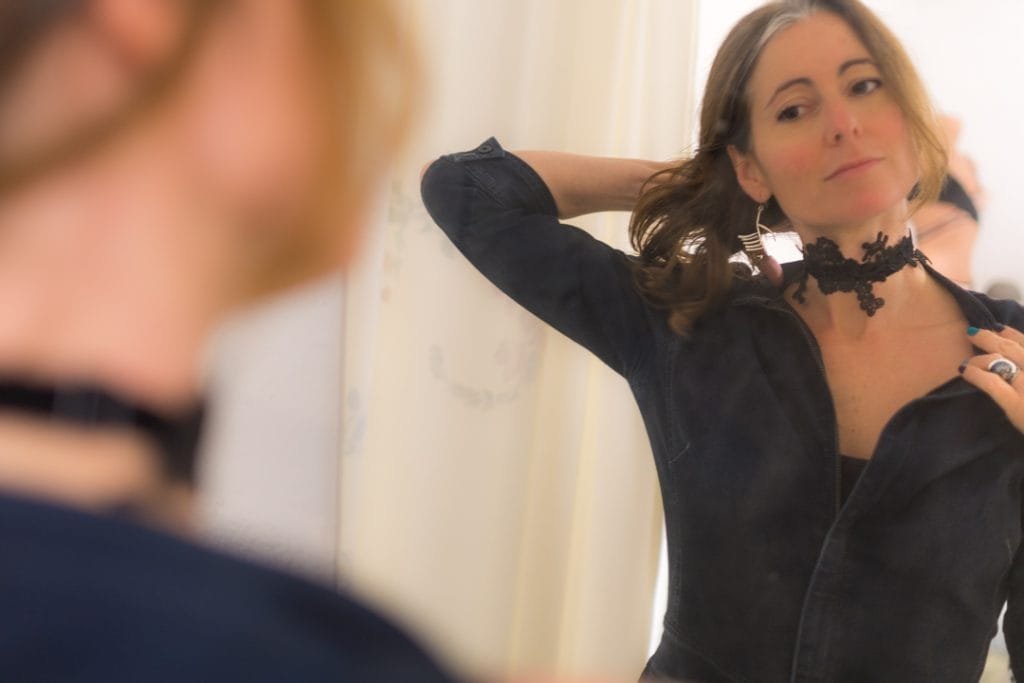
THE SARTORI ATELIER WAY: WEAR YOUR VALUES
Forget mass-made. This is mindful making.
I don’t do factories or fleeting trends. Each piece is touched, crafted, and perfected by hand in my Barcelona studio. This isn’t just slow fashion; it’s intentional creation. Lingerie designed to last, evolve, and become part of your story.
Fabric with a past, lingerie with a future.
I work with rescued deadstock and quality French laces. Limited runs, unique pieces. You’re not just wearing lingerie; you’re wearing a limited edition with soul.
Sustainability is our default, not a buzzword.
For me, “sustainable” isn’t a marketing tactic. It’s in my DNA. I design to eliminate waste, source locally in Catalonia, and craft only what is desired—made-to-order or in tiny batches. Beauty without baggage.
Your body, your rules. I’m just the co-creator.
This isn’t an anonymous transaction. It’s collaboration. You work directly with me to tailor every detail—strap length, metal finishes, specific construction. Lingerie that adapts to your body and spirit, not the other way around. Let’s build your signature piece. Get in touch!
Passing the needle: Own your craft.
Sartori Atelier is also a creative studio. In my workshops, we demystify lingerie design, teaching you to create what you desire with your own hands. You can check out the sewing class.
The difference
There’s an abyss between lingerie that looks good in photos and lingerie that feels good on the body. Between a design made for Instagram and a pattern solved so you can wear it for 12 hours without adjusting it.
I come from a field where precision isn’t style; it’s a requirement. Where perfectionism isn’t luxury; it’s the foundation of the work.
I apply that same logic here.
The promise
Every piece from Sartori has passed through my hands, my body, my technical judgment, and my obsession. Ten versions of a pattern until it disappears on the body. Because the pleasure of wearing something perfect is non-negotiable.
From electrical frequencies to textile fibers.
From invisible signals to invisible seams.
The precision remains the same.
Here, lingerie doesn’t shape you. It reveals you. It’s a second skin that exists for your own pleasure, a personal secret that comforts, a quiet statement that your desire matters.
From my hands to your skin.
No intermediaries.
No compromises.
— Vicky Sartori
Engineer · Pattern Maker · Technical Obsessive
Barcelona, 2025
Want to follow the process? Follow me on Instagram where I document the making without filters—fabric choices, pattern adjustments, the 2am seam unpicking.
Ready for your piece? Write to me and let’s talk about what you’re looking for.
Want to learn to make your own? Check upcoming workshops where I teach lingerie pattern-making and construction.